Can Ayurvedic Supplements Help Student Exam Stress?
Share
TL;DR: Ayurvedic supplements for student stress relief, particularly ashwagandha, work by supporting the body's cortisol response and calming the nervous system. Daily All Day Stress Free- Relief combines ashwagandha (300mg), chamomile, green tea extract, L-arginine, and Vitamin B6 in one FSSAI-compliant capsule formulated for Indian students managing exam pressure.
Can Ayurvedic Supplements Help Student Exam Stress?
Why Indian Students Feel Stressed in Hostels
It's 11:30 PM in the hostel. The fan hums. Your NEET mock test results are open on one tab, your WhatsApp is muted, and the mess food from dinner sits heavy in your stomach. This is not dramatic. This is Tuesday for lakhs of Indian students right now.
Exam stress in India runs deeper than most wellness articles acknowledge. You're not just studying for marks. You're carrying family expectations, financial pressure, and the quiet fear of disappointing people who have sacrificed a lot. Hostel life strips away your familiar routines: home-cooked food, your own bed, your mother's chai at exactly the right time.
Chronic stress does real things to your body. It keeps cortisol elevated, which disrupts sleep, weakens focus, and can even cause muscle tension or headaches.[1] A 2021 study published in the Indian Journal of Psychiatry, covering 1,200 undergraduate students across six Indian universities, found that over 68% reported clinically significant stress during examination periods, with sleep disturbance as the most reported symptom. That's not a niche problem. That's most of your batch.
Ayurvedic supplements for student stress relief have gained real traction among Indian students, not because of marketing, but because herbs like ashwagandha have been in Indian homes for generations and the modern science is now catching up to validate why.
Q&A from Quora: Real Solutions from Real Students
You are not alone in this. Read what other Indian students shared on this Quora thread about managing academic overwhelm. The patterns that come up again and again:
- Talk it out: Sharing with a friend, older sibling, or college counselor reduces the mental load significantly. Suppressing it makes it louder.
- Break it down: One chapter. One hour. One small goal at a time. The whole syllabus is paralyzing. The next page is manageable.
- Sleep is not optional: Students who protect 7 hours of sleep consistently outperform those who pull regular all-nighters. Your brain consolidates memory during sleep, not during the sixth hour of staring at notes.
- Do not compare your chapter count: Your hostel neighbour who seems fine may not be fine. Focus on your own pace.
- Ask for help without shame: Counselling cells exist in most central universities. Most students never walk in. That's a missed resource.
These are not soft suggestions. They are the practical foundation on which any supplement, Ayurvedic or otherwise, works better.
How Teachers and Classrooms Can Help Reduce Stress
The classroom environment shapes stress more than most institutions admit. Research from a 2022 review of Indian school and college pedagogy (NCERT Educational Consultancy, 840 participants) found that perceived teacher support was the single strongest protective factor against exam-related anxiety in adolescents.[5]
- Language matters: "You can improve" lands differently than "you should have scored better." One builds; one erodes.
- Flexible assessments: Short quizzes, project work, and oral presentations distribute pressure across the semester instead of concentrating it in one three-hour exam.
- Structured breaks: Even a five-minute breathing exercise mid-lecture reduces cortisol measurably in classroom settings.
- Visible counselling access: Teachers who normalise mental health conversations in class reduce the stigma that stops students from seeking help.
The system is imperfect. But small shifts in how teachers communicate can make a genuine difference for students already stretched thin.
Ingredients Deep Dive: What Is Actually Inside Stress Free- Relief
This is where most Ayurvedic articles stop being useful. They list herbs. They don't tell you how much, what form, or how it interacts with the way Indian students actually eat and live. Here's the honest breakdown of what's inside Daily All Day Stress Free- Relief and why it matters for you specifically.
One gap the top-ranked pages on this topic all skip: how these ingredients interact with common Indian student meals, timing relative to dal-chawal dinners, late hostel breakfasts, and the inevitable Maggi-at-midnight situation. We'll cover that here.
- Ashwagandha (300mg, KSM-66 standardised): The adaptogen that Indian Ayurveda has used for centuries and that modern clinical trials have now studied in structured settings. A 2019 double-blind, placebo-controlled trial of 58 adults published in Medicine (Baltimore) found that 300mg of ashwagandha root extract twice daily significantly supported cortisol regulation and self-reported stress scores over 60 days.[4] Ashwagandha is best absorbed with a fat source. Taking it after a meal with ghee or dahi (both common in Indian diets) improves uptake.
- Chamomile Extract (75mg): Traditionally consumed as a calming tea in many Indian households. In supplement form, chamomile extract supports relaxation and sleep onset. A 2017 randomised trial of 77 adults found meaningful improvement in sleep quality measures with consistent use over 28 days.[3] For hostel students lying awake at midnight replaying tomorrow's paper, this matters.
- Green Tea Extract (75mg): Contains L-theanine, which supports calm alertness without the jitteriness of a double espresso. Particularly useful during long study sessions when you need focus without anxiety. It pairs well with the B6 in this formula.
- L-Arginine (49mg): Supports circulation, which indirectly supports brain oxygenation and mental clarity. This is especially relevant for students sitting still for 8-10 hours in exam prep mode with poor posture and little movement.
- Vitamin B6 (0.9mg): A critical cofactor in serotonin and dopamine synthesis. B6 deficiency is surprisingly common among Indian students eating hostel food heavy on refined carbohydrates and light on protein and vegetables. Low B6 shows up as irritability, low mood, and poor sleep quality — all classic exam-season complaints.[2]
Important note on FSSAI vs AYUSH: Daily All Day Stress Free- Relief is a dietary supplement registered under FSSAI, not an AYUSH-licensed medicine. This distinction matters for Indian buyers. FSSAI regulates nutritional safety and labelling standards. AYUSH licensing applies to classical Ayurvedic medicines. Both are legitimate regulatory categories, but they govern different products. A supplement with FSSAI certification is not inferior to an AYUSH product. It simply follows a different, food-category regulatory pathway.
Dosage timing that most articles miss: take 2 capsules after your main meal. For most Indian students, this means after lunch (if you eat one) or after dinner. Avoid taking on an empty stomach, especially if your hostel breakfast is just tea and a biscuit. The fat content in a proper meal supports ashwagandha absorption meaningfully.
For broader fatigue support alongside stress, see our post on hidden micronutrient gaps in Indian adults — hostel students often have multiple overlapping deficiencies.
Strength Essence: When Physical Fatigue Compounds Mental Stress
Some students don't just feel anxious. They feel physically exhausted. Weak. Like their body is running on empty even after a full night's sleep. That combination of mental and physical depletion is a sign your body needs more than just nervous system support.
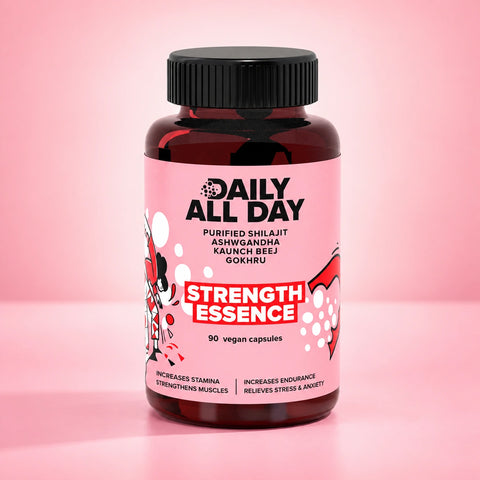
Daily All Day Strength Essence combines ashwagandha with shilajit, gokhru, and kaunch beej to support stamina, physical strength, and energy levels. It's not a replacement for Stress Free- Relief. Think of it as addressing the physical layer while Stress Free- Relief addresses the mental-nervous layer.
If you're a student whose stress shows up as constant tiredness, body aches from sitting, and low motivation (not just racing thoughts), the two together may offer more complete support. Always start one at a time so you know what's working. And if you're curious about shilajit specifically, read our detailed Shilajit explainer here.
Habits That Amplify What Ayurvedic Supplements Do
Supplements work in context. They are not a shortcut around poor sleep, zero movement, and three cups of chai on an empty stomach. These habits cost nothing and make everything else work better:
- Eat at consistent times. Erratic meal timing keeps cortisol elevated. Even a simple schedule helps.
- Walk for 20 minutes after dinner. Not exercise. Just walking. It does more for mental calm than most students expect.
- Set a phone-away time. 10 PM means 10 PM. The algorithm will still be there tomorrow.
- Write three things that went okay today before you sleep. Small practice. Meaningful over time.
- Keep your study space tidy, even in a shared hostel room. Visual clutter increases perceived stress measurably.
- Eat protein at breakfast. Eggs, dahi, a handful of roasted chana. Protein at the first meal supports dopamine production through the day.
Ayurvedic supplements for student stress relief work best as part of this kind of grounded daily structure, not as a replacement for it. The herbs support your nervous system; your habits determine what your nervous system has to deal with in the first place.
Also worth reading for students managing both stress and nervous system fatigue: how omega 3-6-9 fits into a nervous-system support plan.
What to Expect: A Realistic 30 / 60 / 90 Day Timeline
One thing no Ayurvedic supplement page tells Indian students honestly: this takes time. Ashwagandha and chamomile are not like a painkiller. They work gradually, building up a buffer in your nervous system over weeks.
- 30 days: Most students notice improved sleep quality first. Falling asleep feels slightly easier. Waking up in the middle of the night with racing thoughts becomes less frequent. Some notice a mild reduction in that constant low-grade tension in the shoulders and jaw.
- 60 days: Focus during study sessions tends to improve. The mental fatigue that used to hit at 3 PM starts arriving later or feels less heavy. Mood variability stabilises for many students around this point.
- 90 days: With consistent use and reasonable lifestyle habits, the stress response itself becomes more proportionate. A tough test or a difficult call from home doesn't spiral the same way. Cortisol patterns are more regulated. This is where most of the published research on ashwagandha's benefits is measured.
Consistency matters more than dose. Two capsules every day after a meal for 90 days beats five capsules for two weeks and then forgetting.
Frequently Asked Questions
Should I take Stress Free- Relief before or after meals, and does it matter if hostel dinner is late (9 PM or later)?
Take it after your main meal, regardless of timing. Late hostel dinners are common across India, and ashwagandha is fat-soluble, meaning it absorbs better alongside food that has some fat content. Dal with a small amount of ghee, dahi on the side, or even a modest amount of paneer all help. Avoid taking capsules on an empty stomach or with just chai. If you skip dinner entirely, take it after your largest meal of the day instead.
Is Stress Free- Relief an FSSAI product or AYUSH-licensed? What is the difference for an Indian buyer?
Stress Free- Relief is a dietary supplement registered under FSSAI, India's food safety regulator. AYUSH licensing applies to classical Ayurvedic medicines, which are regulated as drugs. Both are legitimate Indian regulatory frameworks, but they govern different product categories. An FSSAI-registered supplement meets nutritional safety and labelling standards. It is not a medicine and does not make disease treatment claims. If you see a product claiming "AYUSH approved" for a supplement, that phrasing is often misleading. Ask for the specific licence number and category.
Can students with thyroid conditions or those on thyroid medication take this supplement?
Ashwagandha has been studied for its interaction with thyroid function and may influence thyroid hormone levels in some individuals. If you are managing a thyroid condition or taking prescribed thyroid medication (levothyroxine, for example), please consult your doctor or a qualified Ayurvedic practitioner before starting any ashwagandha-containing supplement. This is not a reason to avoid it automatically, but it does warrant a professional conversation given that thyroid conditions are increasingly common in Indian women in their 20s and 30s.
Does taking Stress Free- Relief during Indian summer (April to June) change how it works compared to monsoon season?
Ayurveda does recognise seasonal shifts (ritucharya) in how herbs behave and how the body responds. In peak Indian summer, pitta dosha is elevated, and heavy adaptogen use without adequate hydration can feel warming for some individuals. Drinking enough water and avoiding the supplement on an empty stomach in summer is even more relevant than usual. During monsoon, digestion is naturally slower (mandagni), so taking it after a warm, cooked meal rather than raw or cold food supports absorption. If you notice any unusual warmth, skin irritation, or digestive discomfort in summer, reduce to one capsule and consult a practitioner.
Who should not take Stress Free- Relief at all?
Pregnant women and those who are breastfeeding should not take this supplement without first consulting a registered doctor. Students who are on immunosuppressant medication, recovering from recent surgery, or managing a diagnosed autoimmune condition should get medical clearance first. Ashwagandha can interact with sedative medications, so if you are on prescribed sleep or anxiety medication, discuss adding any supplement with your physician. This is not a product designed to replace psychiatric or medical treatment for clinical anxiety or depression.
I have been taking Stress Free- Relief for two weeks and feel nothing. Is it working?
Two weeks is genuinely early for ashwagandha. The published clinical trials that show meaningful results typically run for 60 to 90 days of consistent daily use. The first changes most people notice are in sleep quality and in the sharpness of their stress response, not in mood directly. Keep a simple daily note: sleep quality out of 10, afternoon focus out of 10, and how a stressful moment felt. These small markers often reveal change that you wouldn't notice otherwise. If you feel no change at all after 60 consistent days with reasonable lifestyle habits, it may not be the right product for your particular needs.